
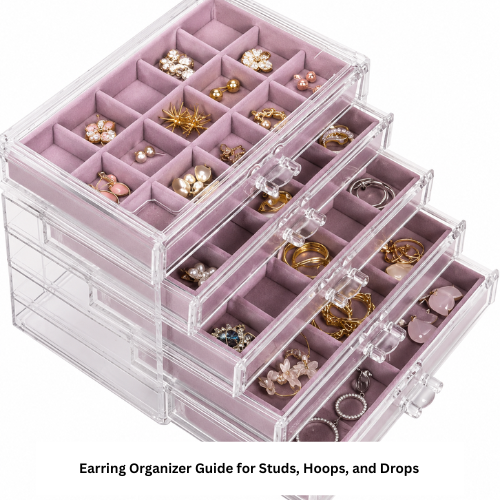
The right earring organizer should keep pairs together, prevent posts and hooks from bending, reduce tangling, and provide enough spacing for different earring shapes. Studs, hoops, huggies, chandeliers, and long drop earrings rarely fit equally well in one type of holder.
Buyers should count their collection by style rather than by total pairs alone. Twenty pairs of studs need a different layout from twenty pairs of large hoops or long drops.
Jewelry box factory shoppers should also check the organizer’s footprint, usable height, backing access, drawer depth, stability, cleaning method, and replacement options.
How to Choose an Earring Organizer by Earring Type
An earring organizer should match the hardware and dimensions of the jewelry.
Begin by grouping earrings into:
- Studs
- Huggies
- Small hoops
- Large hoops
- Hook earrings
- Long drops
- Clip-ons
- Ear cuffs
- Heavy statement pieces
- Delicate or valuable pairs
A broad jewelry organization guide can help owners coordinate earring storage with rings, necklaces, and other pieces without overcrowding compartments.
| Organizer style | Best suited to | Main advantage | Possible limitation | What to verify |
| Hole-panel stand | Studs and hook earrings | Displays many pairs vertically | Backs may be difficult to reach | Hole spacing and rear clearance |
| Rotating tower | Mixed collections | Access from several sides | Needs stable counter space | Base stability and rotation |
| Compartment tray | Studs, huggies, and small hoops | Keeps pairs separated | Long drops may not fit | Compartment dimensions |
| Drawer organizer | Large or mixed collections | Protects jewelry from dust | Earrings may be less visible | Drawer depth and lining |
| Clear acrylic case | Visible storage with dust protection | Easy collection overview | Acrylic can scratch or crack | Panel thickness and drawer movement |
Stud Earring Storage
Studs need secure holes, slots, or small compartments that keep each pair together.
A stud earring holder may work well when the panel provides enough space behind the holes to attach and remove backs comfortably.
Check:
- Hole diameter
- Distance between holes
- Space behind the panel
- Post length
- Backing size
- Panel thickness
- Maximum pair count
- Access from the rear
Very tight spacing can cause decorative fronts to overlap.
Keep backs attached whenever possible. Loose butterfly backs and screw backs are easy to misplace and may create risks around children and pets.
Hoop Earring Storage
Large hoops require vertical clearance and enough distance between neighboring pairs.
Check:
- Hoop diameter
- Hoop thickness
- Closure style
- Weight
- Space beneath the hanging point
- Distance from the base
- Separation between hooks or bars
Hoop earring storage should prevent pieces from resting on the tabletop or pressing against other jewelry.
Small huggies may fit inside compartments, while larger hoops generally work better on bars, hooks, or wide-spaced display panels.
Drop and Dangle Earrings
Long earrings need height and separation.
A display should allow the lowest part of the earring to hang freely without:
- Touching the base
- Tangling with another pair
- Catching on drawer edges
- Bending the hook
- Pressing against a closed lid
Measure the longest pair from hook to bottom before buying.
A shallow jewelry box insert may work for studs but not for long drops. Verify drawer depth and internal height.
Rotating Earring Displays
A rotating earring display can provide access to several panels without requiring a wide wall or drawer.
Before buying, check:
- Number of tiers
- Hole and hook spacing
- Base diameter
- Rotation smoothness
- Weight distribution
- Maximum earring length
- Assembly method
- Stability on smooth surfaces
Place heavier earrings evenly around the stand. Uneven loading can cause wobbling or tipping.
Do not spin a loaded display quickly.
Trays and Drawer Inserts
A 24-compartment earring tray may suit studs, huggies, and small hoops when the compartments match the jewelry dimensions.
Trays can be placed:
- Inside drawers
- On a dresser
- Inside a larger jewelry chest
- In stackable storage systems
- Beneath a protective lid
Check whether the tray slides inside the intended drawer with enough clearance to open and close.
Jewelry box inserts should sit flat without curling or shifting. If stacking trays, verify that the upper layer does not touch raised earrings below.
Five-Drawer and Multi-Layer Storage
A five-drawer earring organizer can separate earrings by material, color, size, occasion, or frequency of use.
Possible categories include:
- Daily studs
- Work earrings
- Evening earrings
- Large hoops
- Long drops
- Sentimental pieces
- Seasonal jewelry
- Repair or cleaning items
Do not mix cleaning chemicals, loose tools, or sharp objects in the same drawer as earrings.
Open Display or Enclosed Storage
An open stand keeps earrings visible and accessible but exposes them to dust, humidity, accidental contact, and sunlight.
An enclosed case can reduce dust but may hide parts of the collection.
Choose based on:
- Room humidity
- Dust level
- Available counter space
- Collection value
- Daily access
- Children or pets
- Visual-display preference
- Cleaning routine
Avoid placing valuable pieces in direct sunlight or near bathroom moisture.
Measuring the Storage Area
Measure the intended dresser, shelf, drawer, or wall area.
Record:
- Available width
- Depth
- Height
- Drawer interior size
- Clearance above rotating stands
- Distance from shelf edges
- Space required to open drawers
- Wall-anchor location when applicable
A tall stand may not fit beneath a shelf. A wide tray may prevent a drawer from closing.
Setup and Assembly
Before loading earrings:
- Compare the pieces with the instructions.
- Assemble the base securely.
- Test the rotation.
- Check every panel.
- Remove protective film when directed.
- Tighten approved fasteners.
- Inspect holes and hooks.
- Place the organizer on a level surface.
- Add earrings gradually.
Do not overtighten plastic or acrylic fasteners.
The Glenor Co earring organizer tray listing can help buyers compare covered tray storage, but verify the current dimensions, slot layout, materials, seller, and package contents.
Conclusion
An earring organizer should fit the actual mix of studs, hoops, and drop earrings rather than only the total number of pairs. Measure the jewelry, choose appropriate spacing and height, check stability and materials, and review cleaning, replacement, warranty, and return information before buying.
FAQ
What organizer is best for stud earrings?
A hole panel or shallow compartment tray can work well when backs remain easy to reach.
How should large hoops be stored?
Hang them on well-spaced bars, hooks, or tall panels where they do not touch the base.
Can drop earrings go in a drawer?
Yes, when the drawer is deep enough and each pair has space to avoid tangling.
Is acrylic or velvet better?
Acrylic improves visibility, while velvet provides a softer surface. The best choice depends on jewelry type and storage location.
How often should an earring holder be cleaned?
Dust or clean it whenever buildup becomes visible and inspect it regularly for rough edges or loose parts.
