
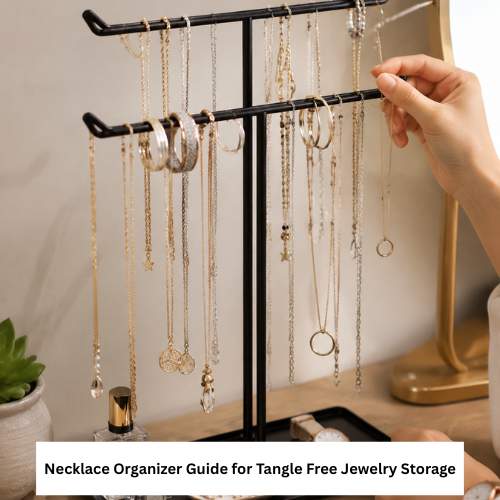
A necklace organizer separates chains, pendants, and layered pieces so they are easier to see and less likely to knot together. The best design depends on necklace length, pendant size, collection volume, travel needs, and available wall, drawer, or dresser space.
How to Choose a Necklace Organizer
Decide whether the collection should hang vertically, lie in divided compartments, or travel in a closed case.
| Storage type | Best use | Main advantage | What to verify |
| Hook stand | Daily necklaces and pendants | Keeps chains visible and separated | Hook spacing, height, and base stability |
| Tiered tray | Necklaces with bracelets and rings | Combines several jewelry types | Tier clearance, lining, and capacity |
| Hanging organizer | Closets and small rooms | Uses vertical space | Hanger strength, pocket depth, and door clearance |
| Travel case | Trips and temporary storage | Limits movement inside luggage | Necklace tabs, case depth, and closure security |
Measure Necklaces and Available Space
Lay the longest necklace flat and measure it from clasp to the lowest point. Hanging storage should provide enough drop length so the pendant does not rest on the tray or overlap another chain.
Measure the dresser, shelf, drawer, closet rod, or door where the organizer will sit. Tall stands may not fit beneath shelves, and hanging products can stop a door from closing.
A necklace organizer with individual hooks should leave enough distance between chains for pendants and clasps. Fine chains may need more separation than thick cords.
Choose Hooks and Stands for Daily Jewelry
A ceramic base necklace holder can provide visible countertop storage, but buyers should verify stand height, hook spacing, base weight, finish quality, and the length of necklaces it can hold.
Distribute weight evenly and keep the stand away from the dresser edge. Check hooks for rough welds, sharp tips, or unfinished surfaces.
Use Tiered Organizers for Mixed Collections
A two tier necklace and bracelet organizer tray can keep chains elevated while holding rings, earrings, or bracelets below, but verify tier height, tray lining, footprint, and total hook count.
Keep long pendants on the highest hooks and shorter chains below when the design permits. Do not stack several fine chains on one hook.
Store Necklaces in a Closed Case
A travel jewelry case for necklaces may help reduce movement during trips, but buyers should check necklace tabs, elastic pockets, case depth, zipper clearance, and usable interior dimensions.
Fasten each necklace and secure the chain at more than one point when tabs or pouches are available. Keep heavy pendants away from thin chains and soft stones.
Do not overfill the case. Pressure from the lid can bend pendants or force chains into nearby compartments.
Use Hanging Storage in Small Spaces
A foldable hanging jewelry organizer can use closet or door space efficiently, but verify hanger strength, pocket visibility, zipper quality, full hanging length, and safe clearance around the door.
Place each necklace in a separate pocket or attachment area. Avoid humid bathrooms and damp closets.
Setup and Tangle Prevention Tips
Clean the storage surface before adding jewelry. Fasten every clasp, use one chain per hook or channel, and separate similar lengths that can swing together.
Store delicate chains flat when a hook is too thick. Use soft separators between metals or stones that may scratch. Keep jewelry away from perfume, cleaning sprays, direct sunlight, and moisture.
For travel, pack the case where it will not be crushed and keep valuable pieces with you when appropriate.
Troubleshooting Common Problems
If chains still tangle, reduce the number on each hook and increase spacing. If necklaces slide off, check the hook angle and clasp position rather than adding adhesive.
If a stand tips, balance both sides or choose a wider base. If a travel case leaves chain marks, use fewer pieces and check whether the interior is too shallow.
Strong odor, sticky lining, loose fibers, or exposed hardware can indicate that the organizer needs cleaning, repair, or replacement.
Cleaning and Maintenance
Dust stands and trays with a soft dry cloth. Follow the care instructions before using water or cleaners on velvet, synthetic leather, wood, metal, or ceramic.
Empty removable trays before cleaning and dry every part fully. Check hooks, zippers, hinges, snaps, and lining for wear.
Common Buying Mistakes
Avoid choosing by appearance alone, forgetting the longest necklace, buying too few hooks, or assuming every travel pocket prevents tangling.
Shoppers can review a PAVILIA tangle free jewelry roll listing as an external comparison, then verify compartment layout, materials, dimensions, seller details, and return terms.
Necklace Storage Buying Checklist
Use this necklace organizer checklist before ordering.
- Count necklaces and measure the longest chain.
- Check hook spacing, compartment length, and pendant clearance.
- Measure dresser, drawer, wall, door, or luggage space.
- Confirm compatibility with chains, pendants, bracelets, and rings.
- Inspect lining, hook finish, base stability, and closures.
- Review setup, travel packing, cleaning, and maintenance directions.
- Check replacement hooks, trays, cushions, or inserts when relevant.
- Review warranty, return policy, delivery protection, and support.
- Verify before buying when dimensions or included parts are unclear.
Conclusion
The right necklace organizer should separate chains, support pendants, fit the available space, and make daily access simple without exposing jewelry to rough surfaces or excess pressure. Jewelry box factory offers relevant stands, trays, travel cases, and hanging storage for buyers comparing tangle free jewelry storage.
FAQ
Should necklaces be stored clasped or unclasped?
Store them clasped when possible. A closed chain is less likely to pass through another chain and form a knot.
Is hanging or flat storage better?
Hanging works well for many everyday chains, while delicate or very long pieces may be safer in separate flat compartments.
How much space should be between hooks?
Allow enough room for the pendant and chain to hang without touching neighboring pieces.
Can necklaces be stored in a bathroom?
A humid bathroom may increase moisture exposure. A dry bedroom, closet, or drawer is usually better.
